News
Diode vs Zener Diode: What's the Difference?
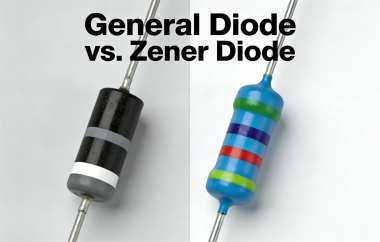
In electronic circuit design, diodes are among the most basic and widely used semiconductor components. However, when faced with standard diodes and Zener diodes (also known as voltage regulator diodes), which may look very similar, many beginners and even experienced practitioners can become confused. Understanding the fundamental differences between the two is critical for proper component selection and for designing stable, reliable circuits. This article takes a deep dive into the core characteristics, operating principles, and key differences of these two types of diodes.
Catalog
I. What Is a Standard Diode?
A standard diode is one of the most basic semiconductor devices used in electronic circuits, and its core structure is a PN junction that provides one-way conductivity. Under forward bias conditions, when the applied voltage exceeds its turn-on voltage, the diode conducts and allows current to flow in a single direction; under reverse bias conditions, the diode presents a high-impedance state and only allows a very small leakage current to pass. The primary functions of standard diodes focus on rectification, signal detection, circuit isolation, and switching control, and they are widely used in power conversion, signal processing, and protection circuits. Common models such as the 1N4001 to 1N4007 series are typically marked clearly with polarity indicators on the body to ensure correct installation. These diodes are designed to optimize forward conduction performance and reverse voltage withstand capability, rather than to operate in the breakdown region.
II. What Is a Zener Diode?
A Zener diode, formally known as a voltage regulator diode, is a specially designed semiconductor device whose core function is to enter a controlled breakdown state at a specific reverse voltage, thereby maintaining a constant voltage across its terminals. Unlike standard diodes, Zener diodes are manufactured using precise doping processes that give them a well-defined and stable reverse breakdown voltage. When the applied reverse voltage reaches the rated Zener voltage, the diode enters its operating region, and even if the current flowing through it varies over a wide range, the voltage across it remains essentially constant. For example, a Zener diode with the model number 1N4735 can stabilize the voltage at 6.2 volts, while a diode marked 3V3 indicates a regulated voltage of 3.3 volts. Zener diodes are mainly used to provide stable voltage references, implement voltage clamping and protection, and achieve voltage regulation in simple power supply circuits, with typical regulated voltage ranges extending from around 3.0 volts to 51 volts or even higher to meet different circuit requirements.
III. Differences
There are fundamental differences between standard diodes and Zener diodes at multiple levels, and these differences define their specific roles in electronic circuits. From an operating perspective, standard diodes are designed to work in the forward conduction region and must avoid entering reverse breakdown, as doing so may cause permanent damage. Zener diodes, on the other hand, are specifically designed to operate in the reverse breakdown region, where the breakdown is controlled and non-destructive, forming the basis of their voltage regulation capability. In terms of functional positioning, standard diodes primarily act as one-way current controllers to achieve rectification and isolation, while Zener diodes serve as voltage stabilizers that ensure a constant potential at a specific point in the circuit.
From a structural design standpoint, there are also significant differences in manufacturing processes. To achieve precise breakdown characteristics, Zener diodes typically use point-contact PN junction designs combined with specific doping techniques to control the breakdown voltage, whereas standard diodes often use junction-area contact structures to handle larger forward currents. In terms of external markings, standard diodes usually only indicate the model number and polarity, while Zener diodes often directly display the regulated voltage value, such as the “3V3” marking on a 1N4728, which represents a 3.3-volt Zener voltage. This intuitive labeling makes it easier for engineers to quickly identify and select the correct component. Regarding electrical parameters, standard diodes focus on maximum rectified current, reverse voltage rating, and switching speed, while Zener diodes emphasize regulated voltage accuracy, dynamic resistance, maximum stabilization current, and temperature coefficient. These fundamental differences make the two types of diodes non-interchangeable in practical circuit designs.
IV. Precautions
In use, it is important to note that Zener diodes should be connected in reverse bias within the circuit, and standard diodes must also be wired with correct polarity, otherwise neither device will deliver the intended performance and circuit faults may occur. From an appearance standpoint, standard diodes are usually easy to identify visually, but it is much harder to distinguish between switching diodes and Zener diodes because they often look very similar. When using a multimeter set to the RX10K resistance range to measure diode polarity, if both measurement directions show resistance values that are relatively close, the device is likely a Zener diode; if the measured forward resistance is noticeably smaller, the device is more likely a switching diode.
V. Conclusion
In summary, standard diodes and Zener diodes are two types of semiconductor devices with completely different functional roles. The core value of a standard diode lies in its one-way conductivity, acting like a check valve in a circuit that controls the direction of current flow and is widely used in rectification and switching applications. The core value of a Zener diode lies in its precise reverse breakdown characteristics, acting like a voltage anchor that firmly locks the voltage across its terminals at a specific level regardless of reasonable current variations, making it a key component in voltage regulation and reference circuits.


