News
What Is the Difference Between a Transistor and a Relay?
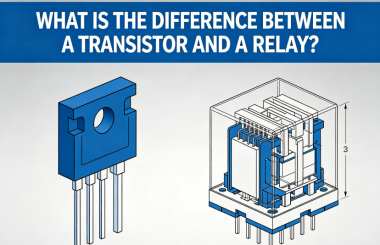
In the electronic components industry, both transistors and relays are fundamental and widely used switching and control devices. They can both control the on/off state of circuits and, to a certain extent, perform signal amplification or power driving functions. However, there are essential differences between them in terms of structure, working principles, and application scenarios. As electronic products continue to evolve toward higher frequency, miniaturization, and intelligence, understanding the differences between transistors and relays is crucial for circuit design and component selection.
I. What Are Transistors and Relays?
A transistor is a semiconductor device and a current-controlled component. It mainly consists of three terminals: the emitter (E), base (B), and collector (C). Depending on the type of charge carriers, transistors can be classified into NPN and PNP structures. In a circuit, a small base current can control a much larger current between the collector and emitter. Therefore, transistors are commonly used for signal amplification and electronic switching control.
A relay is an electromagnetic switching device mainly composed of a coil, iron core, armature, and contact system. When a voltage is applied across the coil, it generates a magnetic field that moves the armature, causing the contacts to open or close and thereby controlling the load circuit. Because there is electrical isolation between the input and output, relays are widely used in industrial control and high-power applications.
II. Working Principles of Transistors and Relays
The operation of a transistor is based on the current control characteristics of semiconductor PN junctions. When the base current changes, the collector current changes proportionally. Transistors typically operate in three regions: cutoff region, active (amplification) region, and saturation region. When operating in the saturation region, a transistor behaves like a closed switch, making it suitable for digital switching applications. In the active region, it can amplify weak signals linearly.
The working principle of a relay is based on electromagnetic induction. When the coil is energized, it generates a magnetic field that attracts the armature, causing the normally open or normally closed contacts to switch states, thereby controlling the circuit. Due to its mechanical structure, relays have relatively slower response times, but they can handle higher voltages and larger currents.
III. Key Differences Between Transistors and Relays
From an electronic engineering perspective, transistors and relays differ in several key aspects:
First, in terms of device type, a transistor is a semiconductor electronic component, while a relay is an electromechanical device that relies on mechanical contacts to switch circuits.
Second, in terms of control method, transistors control current with current and belong to continuous electronic control systems, while relays use electromagnetic force to drive mechanical movement, representing a physical switching method.
Third, in terms of switching speed, transistors are extremely fast and can operate at MHz or even higher frequencies, making them suitable for high-frequency circuits. Relays, limited by mechanical movement, have much slower response times and are generally used in low-frequency or low-speed applications.
Fourth, in terms of electrical isolation, relays naturally provide input-output isolation, enabling low-power control of high-power circuits. Transistors do not inherently provide electrical isolation and require additional circuitry for isolation protection.
Fifth, in terms of lifespan, transistors have no mechanical wear and can theoretically support an extremely high number of switching cycles. Relays, due to mechanical contact wear, typically have a lifespan ranging from tens of thousands to hundreds of thousands of operations before degradation.
Sixth, in terms of electromagnetic interference, transistors generate minimal electromagnetic interference during operation, while relays produce noticeable EMI during switching, requiring additional suppression measures.
In addition, in terms of size and power consumption, transistors are compact and energy-efficient, making them ideal for high-density integrated circuit design. Relays are larger and consume more driving power, but they remain irreplaceable in high-voltage and high-current control applications.
IV. Conclusion
Overall, although both transistors and relays can be used for circuit switching control, their fundamental principles are completely different. Transistors are more suitable for high-speed, low-signal, and low-power electronic system designs, while relays are better suited for industrial applications requiring electrical isolation and high-power control. In practical engineering design, appropriate selection should be made based on load voltage, current level, switching speed, and isolation requirements to achieve optimal system performance and reliability.


