News
What Are the Color Coding Methods of Zener Diodes?
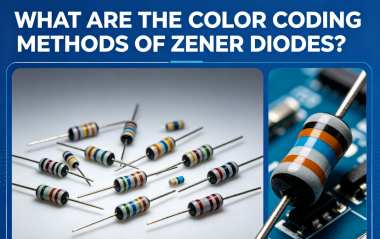
In the electronics components industry, the Zener diode is a fundamental device widely used for voltage stabilization and power protection. It is extensively applied in power supply circuits, signal conditioning circuits, as well as various consumer electronics and industrial control systems. With the trend toward miniaturization and higher reliability in electronic products, engineers increasingly require fast identification and correct selection of Zener diodes. Among the commonly used identification methods in engineering practice, the “color code method” is one of the practical references.
I. What is a Zener Diode?
A Zener diode is a specially designed diode whose core characteristic is its ability to maintain a relatively stable output voltage when operating in the reverse breakdown region. When the reverse voltage reaches its rated breakdown voltage, the device enters a stable conduction state. In this condition, the current may vary significantly, but the voltage remains almost constant. Therefore, it is widely used as a reference voltage source and for overvoltage protection circuits. This characteristic makes it indispensable in low-cost voltage regulation solutions.
II. Characteristics and Advantages of Zener Diodes
Zener diodes feature simple structure, low cost, fast response speed, and relatively high stability. Compared with complex integrated voltage regulator chips, they can achieve basic voltage regulation without additional control circuits. In addition, they are compact in size and highly reliable, making them suitable for space-constrained electronic designs. Furthermore, in transient overvoltage protection applications, Zener diodes can quickly clamp voltage spikes, thereby protecting downstream circuits from damage.
III. Color Code Method and Identification Principle of Zener Diodes
In manufacturing and maintenance processes, some Zener diodes use color rings or color markings to indicate their rated voltage values, allowing for quick parameter identification. It should be noted that different manufacturers may adopt different marking standards; therefore, color coding is generally used as a reference rather than a globally unified standard.
Common color codes and their corresponding typical voltage values are approximately as follows:
Black ring usually indicates about 3.3V, brown 3.9V, red 4.7V, orange 5.1V, yellow 5.6V, green 6.2V, blue 6.8V, purple 7.5V, gray 8.2V, and white 9.1V.
In practical applications, engineers typically combine visual markings, part number printing, and datasheets for comprehensive identification to avoid selection errors caused by variations in color coding.
IV. Auxiliary Identification and Testing Methods for Zener Diodes
In addition to color coding, engineers often use multimeter measurement methods to verify Zener diode characteristics. By applying an appropriate reverse voltage while limiting current, the breakdown voltage can be observed to determine the Zener voltage value. For unmarked or aged components, substitution comparison methods are also used to estimate parameters and improve accuracy.
V. Application Scenarios of Zener Diodes
Zener diodes are widely used in various fields. In power supply circuits, they are used to provide reference voltage or auxiliary regulation. In communication equipment, they are used for signal level clamping and protection. In industrial control systems, they are applied for input overvoltage protection. In consumer electronics, they are commonly used for simple voltage clamping and reference voltage generation. In addition, they are frequently found in LED driver circuits, battery management systems, and interface protection circuits.
VI. Conclusion
As a fundamental electronic component, the Zener diode plays an important role in circuit design and power protection. The color code method provides engineers with a quick identification approach; however, due to the lack of unified industry standards, practical applications still require verification through datasheets and testing methods. A proper understanding of its working principle and identification techniques helps improve circuit reliability and design efficiency while reducing risks caused by incorrect component selection.


