News
What Are the Characteristics of Solid State Relays (SSRs)?
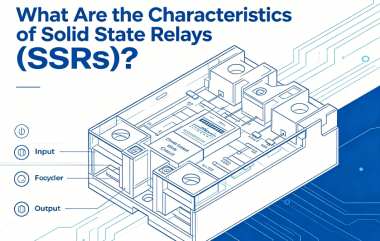
In the electronic components industry, relays play a crucial role in circuit control and electrical isolation, and the performance requirements for these devices continue to increase. Although traditional mechanical relays are widely used, they have certain limitations in terms of switching frequency, service life, response speed, and reliability. Solid State Relays (SSRs), with their contactless design, high reliability, and fast response capabilities, have gradually become an essential component in modern electrical control systems.
In industrial control, power equipment, temperature control systems, automated production lines, and new energy applications, solid state relays have become an important alternative to traditional electromagnetic relays. Understanding the definition, operating principle, and key characteristics of SSRs is highly valuable for electronic engineers, procurement professionals, and equipment manufacturers.
I. What Is a Solid State Relay?
A Solid State Relay (SSR) is an electronic switching device that uses semiconductor components to control the connection and disconnection of electrical circuits. It operates by using an input control signal to drive an internal optocoupler and power semiconductor device, thereby switching the load circuit on or off.
Unlike traditional mechanical relays, solid state relays contain no mechanical contacts. Instead, they utilize electronic components such as Silicon Controlled Rectifiers (SCRs), Triacs, MOSFETs, or IGBTs to perform switching operations. As a result, SSRs not only provide electrical isolation between the input and output circuits but also offer higher reliability and a longer operational lifespan.
Based on output type, solid state relays are generally classified into AC Solid State Relays (AC SSRs) and DC Solid State Relays (DC SSRs). According to their switching method, they can also be categorized into Zero-Cross SSRs and Random Turn-On SSRs to meet the requirements of different applications.
II. Working Principle of a Solid State Relay
A solid state relay mainly consists of three parts: the input control circuit, the isolation circuit, and the output drive circuit.
When a specific voltage or current signal is applied to the control input, the light-emitting diode (LED) within the input circuit is activated and emits light. The optical signal is transmitted through an optocoupler to the output side, providing electrical isolation between the input and output circuits. The photosensitive device on the output side then triggers the power semiconductor component, allowing the load circuit to conduct and begin operation.
When the input signal is removed, the semiconductor device turns off, disconnecting the load circuit and completing the switching process.
Because no mechanical contacts are involved, SSRs can achieve response times in the millisecond or even microsecond range while eliminating issues such as contact wear, electrical arcing, and poor contact performance commonly associated with traditional relays.
III. Features of Solid State Relays
1. High Reliability and Long Service Life
One of the most significant advantages of solid state relays is their contactless structure. Since there are no mechanical contacts, problems such as contact wear, oxidation, and sticking are eliminated. The switching lifespan of an SSR can reach millions or even hundreds of millions of operations, far exceeding that of traditional electromagnetic relays.
In industrial equipment that operates continuously over long periods, SSRs help reduce failure rates and maintenance costs while improving overall system stability and reliability.
2. Fast Response Speed
Because SSRs use electronic switching technology, they do not require mechanical movement to complete switching operations, resulting in significantly faster response times than conventional relays.
Typically, a mechanical relay has an operating time of approximately 5 ms to 20 ms, while an SSR can respond within microseconds to milliseconds. This rapid switching capability makes SSRs particularly suitable for automation systems, precision instruments, and high-speed manufacturing equipment.
3. Spark-Free and Low-Noise Operation
Mechanical relays often generate electrical arcs and mechanical noise during switching. In contrast, solid state relays feature a contactless design that eliminates sparks and mechanical vibration.
This characteristic makes SSRs especially suitable for medical equipment, communication systems, laboratory instruments, and other applications where electromagnetic interference must be minimized. It also enhances overall operational safety.
4. Excellent Resistance to Vibration and Shock
Since SSRs contain no moving mechanical parts, they offer outstanding resistance to vibration and mechanical shock.
Even in demanding environments such as rail transportation, electric vehicles, industrial robots, and construction machinery, SSRs can maintain stable operation without experiencing false triggering or contact-related failures.
5. Low Power Consumption and High Efficiency
The control side of a solid state relay requires relatively low driving power and can be directly connected to PLCs, microcontrollers, and industrial controllers.
In addition, SSRs generally exhibit low switching losses, helping reduce overall energy consumption and improve system efficiency, which aligns with modern energy-saving and sustainability objectives.
6. Excellent Electrical Isolation
SSRs typically employ optical isolation technology to provide safe electrical separation between the control circuit and the load circuit.
This design effectively protects control systems from high-voltage surges, current spikes, and electromagnetic interference, thereby improving system safety and operational stability.
7. Adaptability to Harsh Environments
Solid state relays can operate reliably across a wide temperature range and offer strong resistance to humidity, dust, and corrosion.
As a result, they are widely used in industrial facilities, outdoor equipment, renewable energy systems, and other environments with challenging operating conditions.
IV. Major Applications of Solid State Relays
As intelligent and automated technologies continue to advance, the application scope of solid state relays is expanding rapidly.
In industrial automation, SSRs are widely used in PLC control systems, automated production lines, industrial robots, and CNC machinery to achieve high-frequency switching and load management.
In temperature control systems, SSRs are commonly employed in heaters, electric ovens, injection molding machines, and thermostatic equipment, where fast switching enables precise temperature regulation.
In the renewable energy sector, SSRs are used in photovoltaic inverters, energy storage systems, electric vehicle charging equipment, and battery management systems to improve operational efficiency and reliability.
In medical electronics, solid state relays provide low-noise and highly stable control solutions that meet the stringent reliability requirements of precision instruments.
Furthermore, SSRs play important roles in communication equipment, power systems, railway transportation, smart home devices, and LED lighting control applications.
V. Conclusion
As a key component in modern electronic control systems, solid state relays offer numerous advantages, including high reliability, long service life, fast response speed, spark-free operation, and strong immunity to interference. These benefits are enabling SSRs to gradually replace traditional mechanical relays and become the preferred solution in industrial automation and intelligent control applications.
With the continued growth of Industry 4.0, artificial intelligence, electric vehicles, energy storage systems, and smart manufacturing, demand for high-performance electronic control devices is expected to increase significantly. In the future, solid state relays will play an even more important role across a wider range of applications, providing more efficient, safer, and more reliable solutions for electronic equipment and industrial control systems.


